Types of SASSA Grants
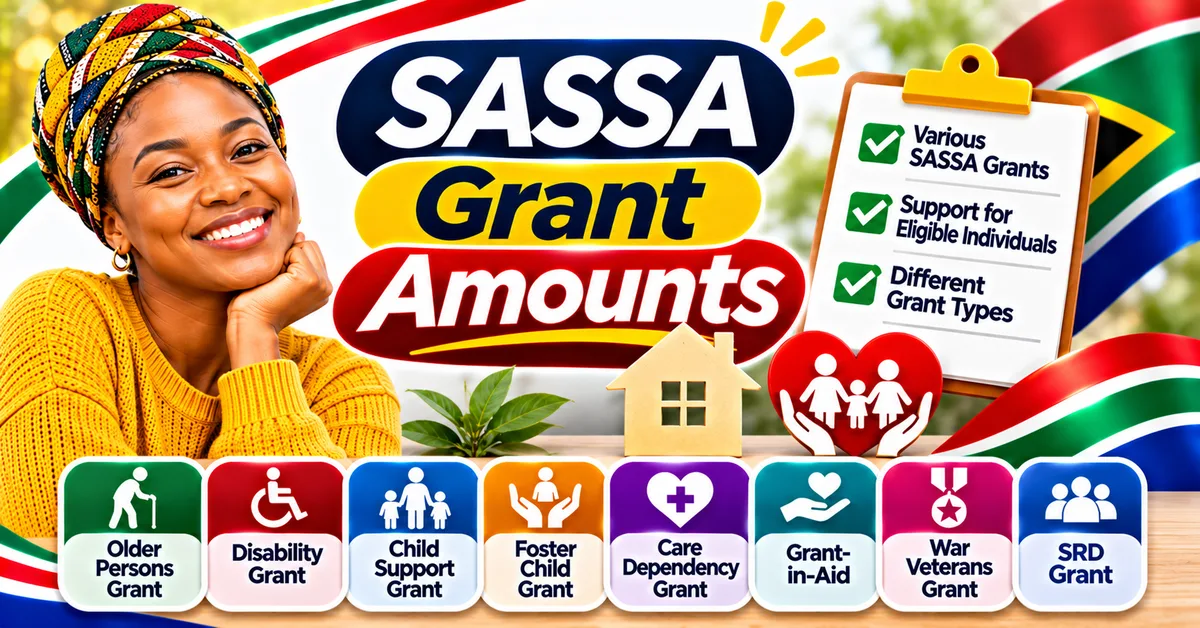
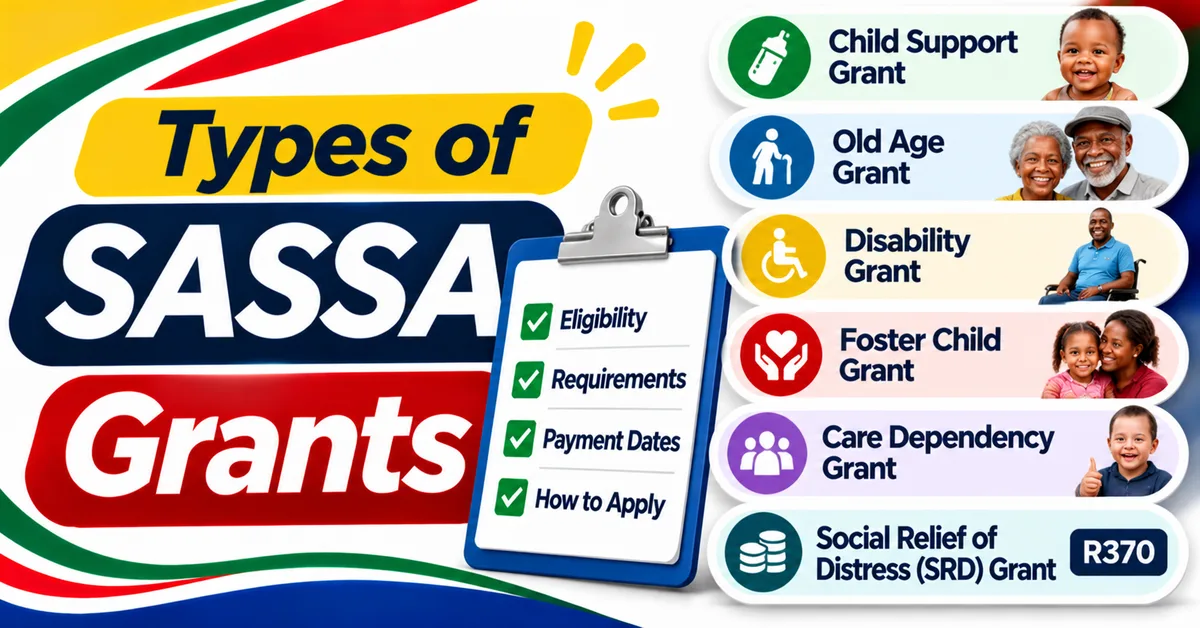
SASSA pays eight social grants in South Africa, plus the temporary SRD R370 grant and one add-on payment, Grant-in-Aid. The eight are the SASSA Older Persons Grant, Disability Grant, War Veterans Grant, Care Dependency Grant, Foster Child Grant, Child Support Grant, Grant-in-Aid and the SRD grant. Each one is for a different group of people, and each has its own age, medical or care requirements.
SASSA Grants at a Glance
SASSA Grant Type Finder
Answer three questions to find which SASSA grant may fit you.
| Grant | Who it is for | Amount per month (2026/27) |
|---|---|---|
| Older Persons Grant | People aged 60 or older | R2,400 (60–74); R2,420 (75+) |
| Disability Grant | Adults 18–59 who cannot work because of a disability | Up to R2,400 |
| War Veterans Grant | Veterans of the Second World War or Korean War, aged 60+ or disabled | R2,420 |
| Care Dependency Grant | Caregiver of a child under 18 with a severe disability needing full-time care | R2,400 |
| Foster Child Grant | Court-appointed foster parent | R1,300 (from 1 October 2026) |
| Child Support Grant | Primary caregiver of a child under 18 | R580 per child |
| Child Support Grant Top-Up | Relative or child-headed household caring for an orphan | R870 total per child (R580 + R290) |
| Grant-in-Aid | Person already receiving an adult grant who needs full-time care from another person | R580 extra |
| SRD Grant | Unemployed adults 18–59 with little or no income | R370 |
Amounts are for the 2026/27 financial year, which ends on 31 March 2027. They took effect from 1 April 2026, except for the Foster Child Grant, which rose from R1,290 to R1,300 on 1 October 2026. Amounts are set in the National Budget and can change — always confirm the current amount with SASSA before you make financial plans.
1. Older Persons Grant
The Older Persons Grant — still widely called the old age pension — is a monthly payment for South Africans aged 60 or older who pass a means test. It pays R2,400 a month from age 60 to 74, and R2,420 a month from age 75. The extra R20 from age 75 is automatic.
You must be a South African citizen, permanent resident or recognised refugee, live in South Africa, and not already receive another social grant for yourself. You must also not be cared for in a state institution. SASSA checks your income and assets, and your spouse's income and assets if you are married, under the means test. The amount you receive can be less than the maximum if you have other income, because the grant is paid on a sliding scale.
2. Disability Grant
The SASSA Disability Grant is for adults aged 18 to 59 whose physical or mental disability prevents them from working for at least six months. It pays up to R2,400 a month. The grant can be temporary or permanent, depending on the medical assessment.
A state-appointed doctor must assess you — your own doctor's note alone is not enough. You must also be a South African citizen, permanent resident or recognised refugee living in South Africa, not be cared for in a state institution, and pass the means test on income and assets. At age 60, a Disability Grant changes to the Older Persons Grant.
3. War Veterans Grant
The War Veterans Grant is for people who served in the Second World War (1939–1945) or the Korean War, and who are aged 60 or older or disabled. It pays R2,420 a month. Because of the age of the people who qualify, very few new applicants remain, but the grant is still paid to those who qualify.
Applicants must be South African citizens or permanent residents living in South Africa, and must pass the means test. Proof of war service is required.
4. Care Dependency Grant
The Care Dependency Grant is paid to the parent or primary caregiver of a child under 18 with a severe disability who needs full-time, special care at home. It pays R2,400 a month.
The child must be assessed as needing permanent care, and must not be permanently cared for in a state institution. The caregiver must be a South African citizen, permanent resident or recognised refugee living in South Africa, and must pass the means test. A medical assessment of the child is required.
5. Foster Child Grant
The Foster Child Grant is paid to a court-appointed foster parent for each child placed in their care by a court order. It pays R1,300 a month per child from 1 October 2026 (R1,290 from April to September 2026).
Unlike most other SASSA SRD grants, the Foster Child Grant is not means tested. The foster parent must have a valid court order placing the child in their care, and the child must be under 18. A fostered child with a severe disability may also qualify for a Care Dependency Grant, which is a separate grant.
6. Child Support Grant
The SASSA Child Support Grant is SASSA's most widely received grant. It pays R580 a month per child to the child's primary caregiver — the person who takes main responsibility for the child's daily care. That can be a parent, grandparent, another relative, or an older sibling heading a household.
The child must be under 18, live with the caregiver in South Africa, and not be permanently cared for in a state institution. The caregiver must be a South African citizen, permanent resident or recognised refugee, and must pass the means test, which looks at income only — there is no asset test for this grant. A caregiver cannot claim for more than six children who are not their biological or legally adopted children.
The Child Support Grant Top-Up adds R290 a month, bringing the total to R870 a month per qualifying child, for a relative or a child-headed household caring for a child who has lost both parents.
7. Grant-in-Aid
Grant-in-Aid is not a grant on its own. It is an extra R580 a month added to an existing Older Persons, Disability or War Veterans Grant, for a person who needs regular, full-time care from another person because of a physical or mental disability.
You cannot apply for Grant-in-Aid by itself — you must already receive one of those three adult grants. A medical assessment is required to confirm that full-time care is needed.
8. SRD R370 Grant
The Social Relief of Distress (SRD) grant is temporary relief, not a permanent grant. It pays R370 a month to unemployed adults aged 18 to 59 who have little or no income and do not receive another social grant.
Applicants must pass a means test: bank inflows of R624 a month or less. The grant has been extended to 31 March 2027. Unlike the permanent grants, the SRD grant is applied for online only, at srd.sassa.gov.za, and it has no fixed payment date — each person's pay date appears on their status page on the SRD portal.
Which Grant Can I Get?
Use this short guide to find the grant that fits your situation. You can only receive one grant for yourself, except for Grant-in-Aid, which is added to an adult grant, and a caregiver can hold grants for more than one child.
| Your situation | Grant to look at |
|---|---|
| Aged 60 or older, little income | Older Persons Grant |
| Aged 18–59, cannot work because of a disability | Disability Grant |
| Caring for a child under 18 | Child Support Grant |
| Court-appointed foster parent | Foster Child Grant |
| Caring for a child with a severe disability | Care Dependency Grant |
| Already on an adult grant and need full-time daily care | Grant-in-Aid |
| War veteran, aged 60+ or disabled | War Veterans Grant |
| Unemployed, 18–59, no other grant or income | SRD R370 Grant |
If more than one row seems to fit, read the full guide for each grant before you apply. Applying for the wrong grant wastes time, and a declined application for one grant does not automatically mean you qualify for another.
How to Apply for a SASSA Grant
Permanent grants are applied for at a SASSA office or online at services.sassa.gov.za. The SRD grant is applied for online only, at srd.sassa.gov.za. Take your South African ID document when you apply in person, and be ready to provide the documents SASSA asks for — for example, proof of income, a medical assessment for a disability-related grant, or a court order for a foster child grant.
[VERIFY] The exact documents for each grant are not listed in full here, because the list depends on the grant and on your circumstances. Confirm the documents for your grant with SASSA on 0800 60 10 11 or at your nearest office before you travel.
Applications are free. Never pay anyone to apply for you, and never share your ID number, OTP or banking details with someone who contacts you first.