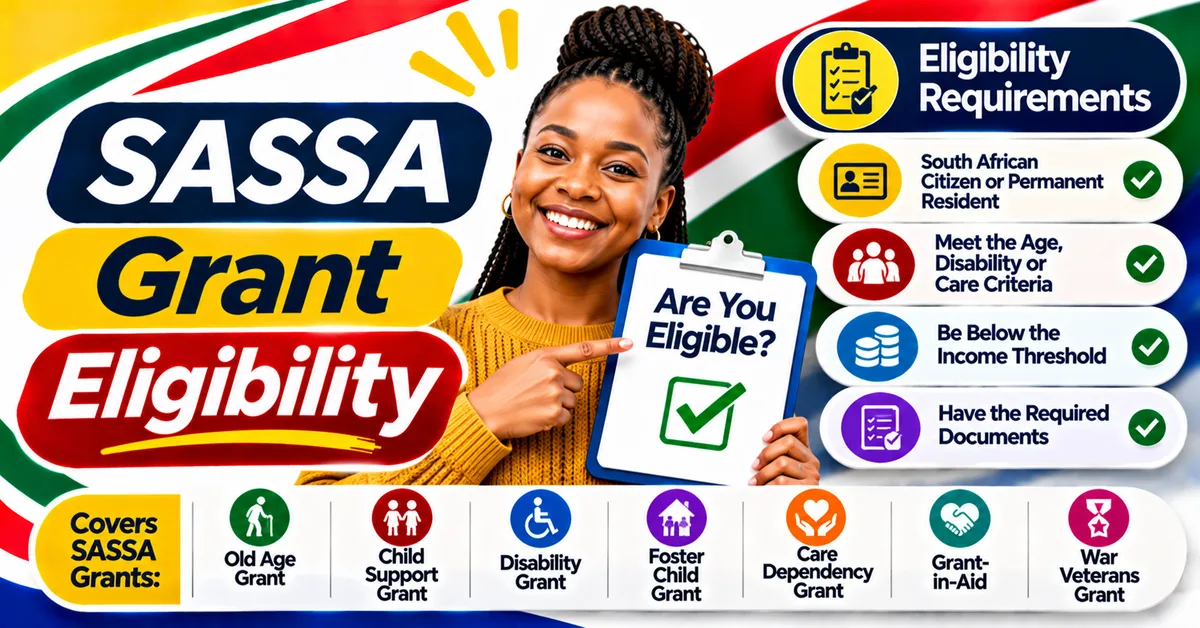
SASSA Grant Eligibility
To qualify for a SASSA grant, you must be a South African citizen, permanent resident or recognised refugee living in South Africa, meet the age or care rule for that grant, and pass its means test — except the Foster Child Grant, which has no means test. You must also not receive another social grant for yourself.
There is no single set of SASSA eligibility rules: eight permanent grants plus the temporary SRD grant each combine age, care, medical and income rules differently. This independent guide — not an official SASSA publication — sets out the shared rules first, then each grant's rules. Confirm the current rules with SASSA at sassa.gov.za or at a SASSA office.
Who Can Apply for a SASSA Grant? The Shared Rules
SASSA Grant Eligibility Checker
Check who qualifies for each SASSA grant and what it pays.
Most grants share the same starting requirements.
- Residency and status: You must be a South African citizen, a permanent resident, or a recognised refugee living in South Africa. The exact wording varies slightly from grant to grant.
- One grant for yourself: You must not receive another social grant for yourself. Grant-in-Aid is the exception: it is an add-on paid on top of an Older Persons, Disability or War Veterans grant when you need full-time care. A child grant collected as a caregiver is not a grant for yourself, so it does not by itself count against an SRD application. If unsure, confirm with SASSA.
- Not in a state institution: For most grants — in particular Older Persons, Disability and War Veterans — you must not be cared for in a state institution.
- A means test: Every grant except the Foster Child Grant has one, with different limits — see the table below.
- The right age or care situation: Each grant is aimed at a particular group — older people, people with a disability, caregivers, foster parents, war veterans, or adults with no income.
SASSA Grant Eligibility at a Glance
| Grant | Who it is for | Age rule | Means test |
|---|---|---|---|
| Older Persons Grant | Age 60+ | 60+ | Income and assets |
| Disability Grant | Cannot work because of a disability | 18–59, medically confirmed | Income and assets |
| Child Support Grant | Primary caregiver of a child | Child under 18 | Income only |
| Foster Child Grant | Foster parent (court order) | Child under 18 | None |
| Care Dependency Grant | Caregiver of a child needing permanent care | Child under 18, medical assessment | Income only |
| War Veterans Grant | War veterans | 60+ or disabled | Income and assets |
| Grant-in-Aid | Needs full-time care, already on a main grant | Follows the main grant | Follows the main grant |
| SRD R370 Grant | Insufficient means, no other grant for self | 18–59 | Monthly bank inflows only |
For the amounts, see the SASSA grant amounts guide (proposed slug: sassa-grant-amounts).
The Means Test Explained
The means test checks your income — and, for some grants, your assets. Above the limit, you will not qualify, even if you meet the age rule.
| Grant | Income limit | Asset limit |
|---|---|---|
| Older Persons / Disability Grant | Single up to R112,200/yr (~R9,350/mo); married combined R224,400/yr (~R18,700/mo) | Single R1,584,000; married R3,168,000 |
| Child Support Grant | Single caregiver up to R69,600/yr (R5,800/mo); married combined R139,200/yr (R11,600/mo) | No asset test stated |
| Foster Child Grant | No means test | No means test |
| Care Dependency Grant | Single: R223,200/year; married: R446,400/year (see [VERIFY] below) | [VERIFY] — no asset limit confirmed |
| War Veterans Grant | See [VERIFY] below — two conflicting figures are in circulation | See [VERIFY] below |
| Grant-in-Aid | Follows the main grant | Follows the main grant |
| SRD R370 Grant | Less than R624/month in bank inflows, re-checked monthly | No asset test |
The Older Persons and Disability figures are the 2026/27 figures, because several secondary sources agree on them. If you are close to the limit, confirm them with SASSA.
[VERIFY] — Older Persons / Disability income limit: one secondary source quoted lower 2026 figures (R107,880/year single, R214,680/year married). The table figures (R112,200 / R224,400) are the ones several other sources agree on for 2026/27; borderline applicants should confirm with SASSA.
[VERIFY] — Care Dependency income limit: gov.za lists R223,200/year single and R446,400/year married (the table figure). Other sources quote R288,000 / R576,000 or R256,800 / R513,600. Confirm a borderline figure with SASSA. No asset limit is confirmed.
[VERIFY] — War Veterans income limit: gov.za (June 2026) listed R86,280/year single; other 2026/27 sources list R112,200/year single and R224,400/year married, with assets R1,584,000 / R3,168,000. Neither is settled — confirm with SASSA.
In practice: Older Persons, Disability and War Veterans test income and assets; Child Support and Care Dependency test income only; married applicants are tested together. SRD tests only monthly bank inflows (under R624), re-checked monthly. Foster Child has no means test.
Eligibility Rules by Grant
Older Persons Grant: 60 or older, not cared for in a state institution, not receiving another grant for yourself, and passing the income and asset means test with your spouse if married. It pays R2,400 a month from age 60 to 74, and R2,420 from age 75. See the Older Persons Grant guide (proposed slug: sassa-older-persons-grant).
Disability Grant: aged 18 to 59, with a disability confirmed by a medical assessment, plus the same residency, state-institution, one-grant and means-test rules as the Older Persons Grant. See the Disability Grant guide (proposed slug: sassa-disability-grant).
Child Support Grant: primary caregiver of a child under 18, both living in South Africa, with income within the limit above. Income only is tested. It is paid per child, and relatives caring for an orphaned child may qualify for the Top-Up (R870 a month for that child). See the Child Support Grant guide (proposed slug: sassa-child-support-grant).
Foster Child Grant: foster parent of a child under 18, with the placement confirmed by a valid court order. The only SASSA grant with no means test. See the Foster Child Grant guide (proposed slug: sassa-foster-child-grant).
Care Dependency Grant: primary caregiver of a child under 18 who needs permanent care because of a disability, with a medical assessment of the child as part of the application. Not for foster parents. Confirm the income limit with SASSA — it is disputed. See the Care Dependency Grant guide (proposed slug: sassa-care-dependency-grant).
War Veterans Grant: war veteran aged 60 or older, or a war veteran with a disability, plus the same residency, state-institution, one-grant and means-test rules as the Older Persons Grant. Confirm the limits with SASSA — they are disputed between sources. See the War Veterans Grant guide (proposed slug: sassa-war-veterans-grant).
Grant-in-Aid: not a stand-alone grant. You may qualify only if you already receive an Older Persons, Disability or War Veterans grant and need full-time care. It follows the means test of your main grant and is paid as an add-on of R580 a month. See the Grant-in-Aid guide (proposed slug: sassa-grant-in-aid).
SRD R370 Grant: aged 18 to 59, not receiving another social grant for yourself, with less than R624 a month coming into your bank account, re-checked monthly. Funded to 31 March 2027, applied for online only at srd.sassa.gov.za. See the SRD R370 guide (proposed slug: srd-r370-grant) and the SRD application guide (proposed slug: srd-r370-grant-application).
Which Grant Fits Your Situation?
- 60 or older with a low income: the Older Persons Grant.
- 18 to 59 and a disability stops you from working: the Disability Grant — you will need a medical assessment.
- Caring for a child under 18 with a low income: the Child Support Grant, paid per child. Relatives caring for a child who has lost both parents should ask about the Top-Up.
- Foster parent with a court order: the Foster Child Grant. There is no means test.
- Caring full-time for a child under 18 with a severe disability: the Care Dependency Grant. Confirm the income limit with SASSA first — sources disagree on it.
- War veteran aged 60 or older, or disabled: the War Veterans Grant. Confirm the income limit with SASSA first — sources disagree on it.
- Already getting a grant and now needing full-time care: Grant-in-Aid, as an add-on.
- 18 to 59, unemployed or earning very little, with no other grant for yourself: the SRD R370 grant, with bank inflows under R624 a month.
Remember the one-grant rule: you cannot receive two grants for yourself. A caregiver can still apply for a grant for themselves, such as SRD, alongside a child grant.
How to Check Your Eligibility Before You Apply
- Identify the grant that fits your situation using the table and scenarios above.
- Check the age or care rule for that grant, then check the means test — your income, and your spouse's combined income if married, plus assets where tested.
- Check the shared rules: residency status, whether you receive another grant for yourself, and whether you are cared for in a state institution.
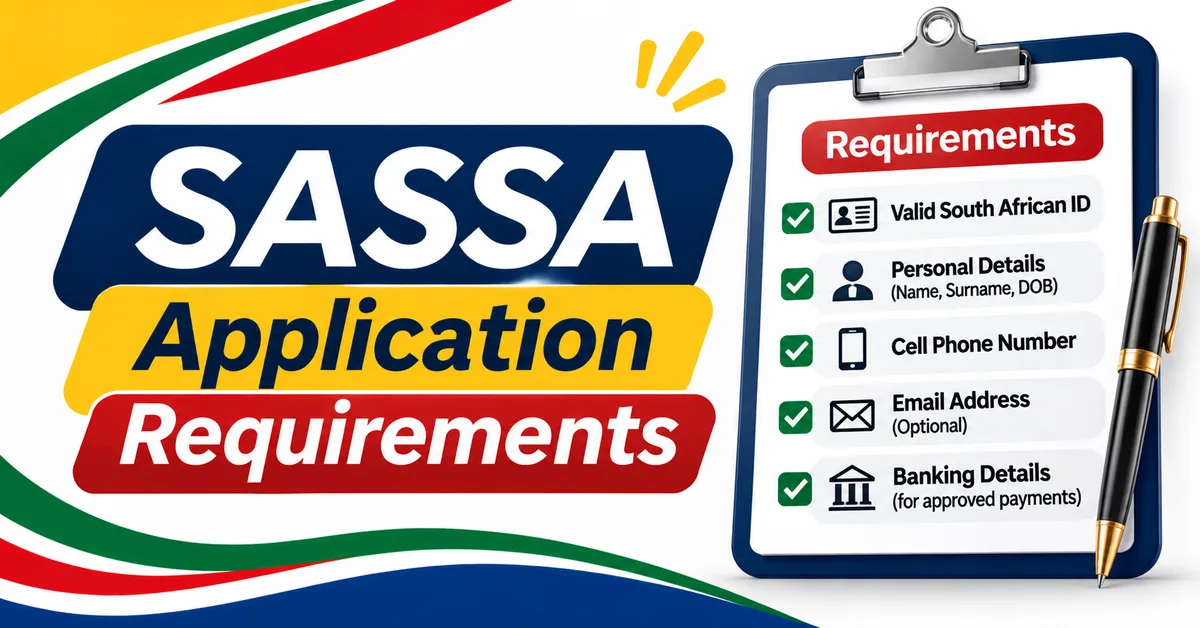
- Gather the documents you will need. They differ by grant; see the application requirements guide (proposed slug: sassa-application-requirements-documents).
- Confirm anything marked [VERIFY] with SASSA, especially near a limit — call 0800 60 10 11, email [email protected], or visit a SASSA office.
- Apply through the right channel. Permanent grants: a SASSA office or services.sassa.gov.za. SRD: online only at srd.sassa.gov.za. See the online application guide (proposed slug: sassa-online-application).
What to Do If You Do Not Qualify or Your Application Is Declined
Not qualifying for one grant does not mean you qualify for none — someone turned down for the Disability Grant may still qualify for SRD. An age rule cannot be worked around, while a means-test failure may change if your income falls.
If SASSA declines your application and you believe the decision is wrong, ask for it to be reconsidered or appeal it. The routes differ by grant. For SRD, see the SRD appeal guide (proposed slug: sassa-srd-appeal). For other grants, ask SASSA what route applies, and keep your application reference number — see the reference-number tracking guide (proposed slug: sassa-application-reference-number-tracking). For help, contact SASSA on 0800 60 10 11 or [email protected].