SASSA Grant-in-Aid
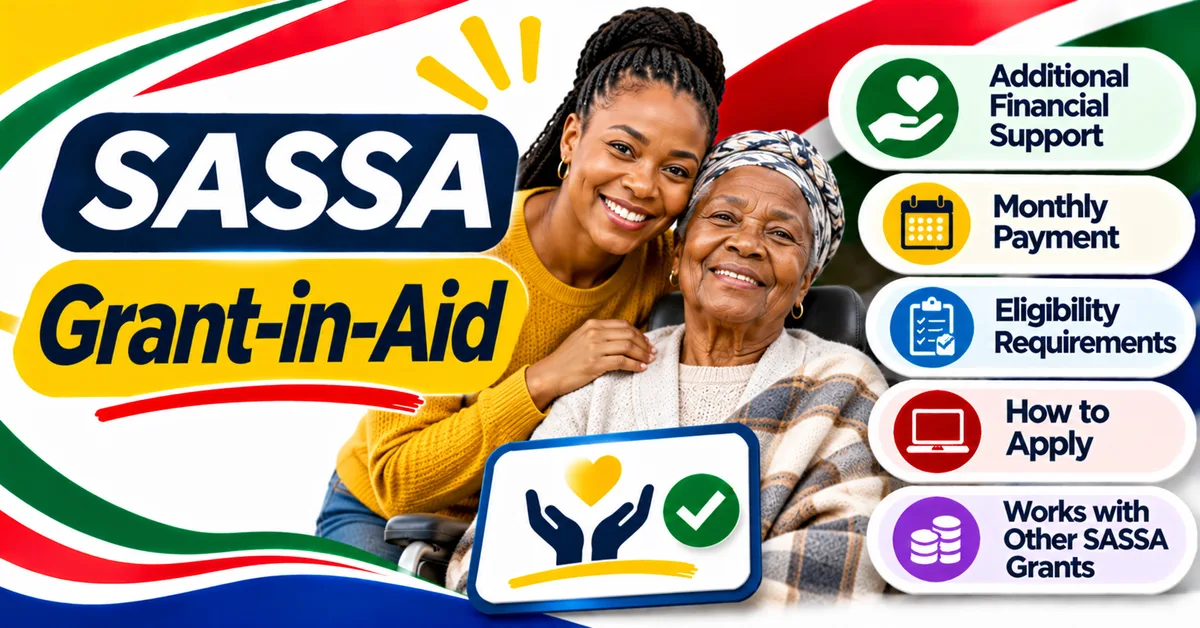
The SASSA Grant-in-Aid is an extra R580 a month, paid on top of an SASSA Older Persons Grant, Disability Grant or War Veterans Grant, for a person who cannot look after themselves because of a physical or mental disability and needs full-time care from another person. It is not a grant on its own: you must already receive one of those three grants to qualify.
What Is the SASSA Grant-in-Aid?
SASSA Grant Amount Calculator
Add up the SASSA grants you receive.
The Grant-in-Aid is an add-on payment. It exists to help pay the person who takes full-time care of you when you cannot manage daily life on your own. The South African Government's service page describes it plainly: if you are living on a social grant but cannot look after yourself, you can get an additional grant to pay the person who takes full-time care of you.
Three points matter most, and they cause most of the confusion about this grant:
- It is an add-on, not a standalone grant. You cannot apply for the Grant-in-Aid on its own. If you do not already receive an Older Persons Grant, a Disability Grant or a War Veterans Grant, you do not qualify.
- It is for full-time care, not occasional help. You must be unable to look after yourself because of a physical or mental disability, and you must need full-time care from another person.
- It stops when the main grant stops. If your main grant ends for any reason, the Grant-in-Aid ends with it.
The payment is made to you, the grant recipient, together with your main grant — it is not paid directly to the person who cares for you. How you use it to pay or thank your carer is up to you.
How Much Is the Grant-in-Aid?
The Grant-in-Aid pays R580 per month from 1 April 2026. Before that date it was R560 a month, so the April 2026 increase added R20.
The table below shows what the add-on means in practice when it is combined with the main grants it can be added to. The main-SASSA grant amounts are the April 2026 amounts.
| Main grant you already receive | Main grant (from 1 Apr 2026) | Plus Grant-in-Aid | Total per month |
|---|---|---|---|
| Older Persons Grant, age 60–74 | R2,400 | R580 | R2,980 |
| Older Persons Grant, age 75 and older | R2,420 | R580 | R3,000 |
| Disability Grant | R2,400 | R580 | R2,980 |
| War Veterans Grant | R2,420 | R580 | R3,000 |
The Grant-in-Aid is paid with your main grant, through the same payment method. [VERIFY] The exact date from which the Grant-in-Aid is paid after approval — for example, whether it is backdated to the date you applied — was not confirmed against an official source during this draft, so no backdating claim is made here. Ask at your SASSA office when you apply.
Who Qualifies for the Grant-in-Aid?
You must meet all three conditions set out on the gov.za service page:
- You already receive a qualifying grant. You must already get a Disability Grant, a War Veterans Grant or an Older Persons Grant. No other grant qualifies. That means, for example, a Child Support Grant, a Foster Child Grant or a Care Dependency Grant on its own does not open the door to a Grant-in-Aid.
- You cannot look after yourself and need full-time care. You must not be able to look after yourself because of your physical or mental disability, and you must therefore need full-time care from someone else. This is about regular, daily help with the ordinary tasks of living — not a short illness or a temporary injury.
- You are not cared for in a subsidised institution. You must not be cared for in an institution that receives a subsidy from the government for your care or housing. The reason is straightforward: if the state is already paying for your care in such an institution, it does not pay the add-on as well.
There is no separate age test for the Grant-in-Aid itself. The age rules come from the main grant you already hold — for example, the Older Persons Grant already requires you to be 60 or older.
What "full-time care" means in practice
Full-time care means you need another person with you regularly to help with daily living because of your disability. The medical report is what proves this, and it is the most important document in the application. It must show that you cannot look after yourself and that you need full-time care — a vague note saying you are unwell is not enough.
[VERIFY] Whether the medical report must come from a state-appointed doctor, or whether a report from a private doctor is also accepted, was not confirmed against the gov.za service page during this draft, and secondary sources disagree on this point. The gov.za page requires a medical report or assessment report less than three months old showing that you need full-time care. Ask SASSA which doctors' reports it accepts before you pay for an assessment.
Is there a separate means test?
[VERIFY] Some secondary sources state that there is no separate means test for the Grant-in-Aid and that it simply follows the means test of your main grant. That claim appears only in secondary sources and was not confirmed on the gov.za service page during this draft, so it is flagged here rather than stated as a confirmed rule. In practice you have already passed the means test of your main grant, but confirm with SASSA whether any further income or asset check applies to the Grant-in-Aid itself.
Documents You Need to Apply
Take the following to your nearest SASSA office, as listed on the gov.za service page:
- Your 13-digit bar-coded identity document (ID). Take the original.
- Proof of your marital status and your spouse's identity, where applicable.
- A medical report or assessment report, less than three months old, that shows you need full-time care. This is the core document. If the report is older than three months when you submit your application, it will not be accepted and you will need a new one.
It is also sensible to take proof that you already receive a qualifying grant, such as your SASSA card or a grant confirmation letter, so the office can find your record quickly. [VERIFY] That item is not listed on the gov.za service page quoted above, so it is suggested here as a practical step, not as a confirmed official requirement.
Do not pay anyone for the application. The service is free.
How to Apply for the Grant-in-Aid
- Go to the SASSA office nearest to where you live. The Grant-in-Aid application is made in person. Application forms are not available online, but you can get them from your nearest SASSA office.
- Take the documents listed above with you. The medical report must be less than three months old on the day you apply.
- Complete the application form at the office. SASSA staff will help you fill it in if you need help. Make sure the form is completed in full and that you understand what you are signing.
- Keep any receipt or reference you are given. You will need it if you have to follow up on the application.
- Wait for SASSA to process the application. The gov.za service page states that it may take up to three months to process your application.
If you are too old or sick to travel to the office, a family member or friend can apply on your behalf, according to the gov.za service page. [VERIFY] The exact procedure for applying on someone else's behalf — for example, whether a letter of authority, a doctor's note or a home visit is required — was not confirmed during this draft, so ask the SASSA office what it needs before someone goes on your behalf.
You can also check the gov.za grant-in-aid service page at https://www.gov.za/services/social-benefits/grant-aid for the official description, and the SASSA website at sassa.gov.za for general information.
What Happens After You Apply
Once your application is submitted, SASSA checks your documents and your medical report, and confirms that you already receive a qualifying grant and are not cared for in a subsidised institution.
If your application is approved, the R580 is added to your monthly payment. If it is declined, you should be told why. [VERIFY] The exact appeal or reconsideration route for a declined Grant-in-Aid application was not confirmed against an official source during this draft, so no appeal steps or deadlines are stated here. If your application is declined, ask the SASSA office for the reason in writing and for the correct next step, or call the SASSA toll-free line on 0800 60 10 11.
If your main grant is suspended or cancelled, the Grant-in-Aid stops with it, because it cannot stand on its own. The same applies if your circumstances change — for example, if you move into an institution that receives a government subsidy for your care. Tell SASSA about changes in your circumstances rather than waiting for SASSA to find out.
Common Mistakes to Avoid
- Applying without a qualifying grant. The Grant-in-Aid cannot be your first or only grant. Sort out the main grant first.
- Using an old medical report. A report older than three months will not do. Get a fresh assessment before you go to the office.
- Applying online. The form is not available online. Going to the office in person is the route given on the gov.za page.
- Paying someone to apply for you. The application is free. Anyone charging a fee to apply on your behalf is not acting for SASSA.
- Assuming the carer is paid directly. The money is paid to you with your main grant. It is your responsibility to use it towards the cost of your care.
Grant-in-Aid and Your Carer
The Grant-in-Aid recognises that full-time care has a cost, but it does not employ your carer and it does not create a formal employment relationship between SASSA and the person who looks after you. It is simply an additional R580 a month paid to you because you need that care.
If the person caring for you is a family member, that does not disqualify you. What matters is the need for full-time care, proven by the medical report, and the fact that you already receive one of the three qualifying grants.