SASSA Foster Child Grant
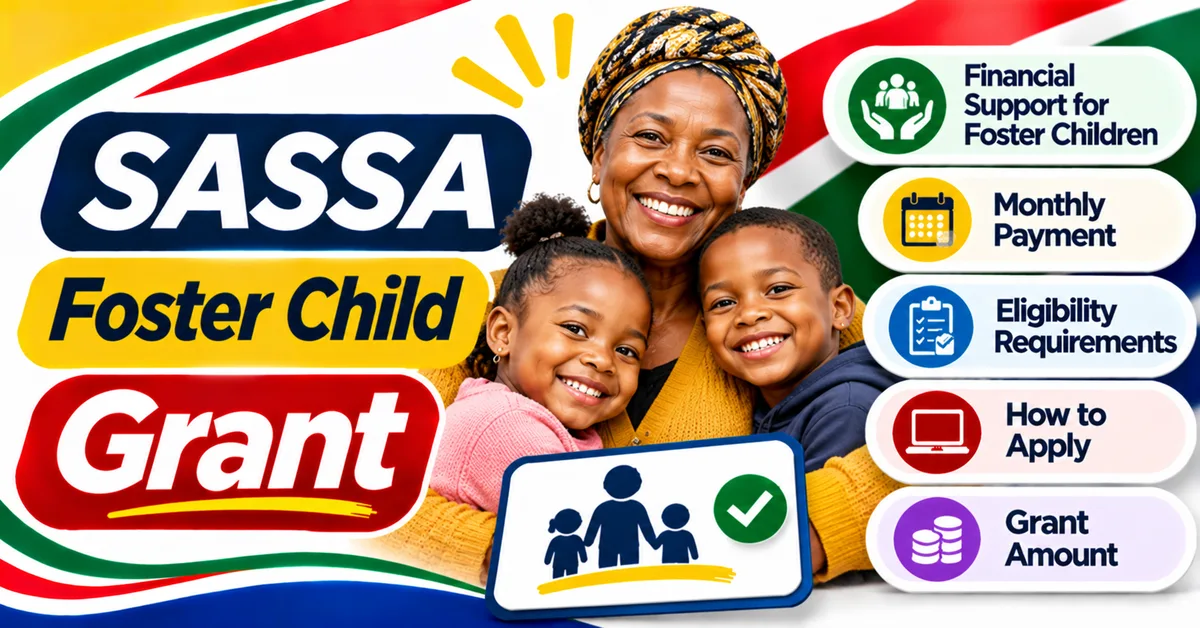
The SASSA Foster Child Grant pays R1,300 per month for each foster child in your care, from 1 October 2026. It is only for a child placed with you by a Children's Court order — without that court order, you cannot get the grant. There is no means test, so your income does not matter.
What Is the SASSA Foster Child Grant?
SASSA Grant Eligibility Checker
Check who qualifies for each SASSA grant and what it pays.
The Foster Child Grant is a monthly payment from the South African Social Security Agency (SASSA) to help a foster parent care for a child legally placed in their care by a Children's Court, covering food, clothing, schooling and other everyday needs.
It is different from the SASSA Child Support Grant, which is for a child's primary caregiver and has a means test. The Foster Child Grant is specifically for foster care, is based on a court order, and has no means test. A foster parent can also apply for the Care Dependency Grant for the same child if that child has a severe disability — SASSA's own grants information notes that a foster parent may receive both grants for the same child.
How Much Is the Foster Child Grant?
The Foster Child Grant pays R1,300 per child, per month, from 1 October 2026. Before that, from April to September 2026, the amount was R1,290 per child per month.
| Period | Amount per child per month |
|---|---|
| 1 April 2026 – 30 September 2026 | R1,290 |
| From 1 October 2026 | R1,300 |
The grant is paid per child, so if you foster more than one child and each child qualifies, you receive the grant for each of them. The grant is paid from the date of the court order, according to SASSA's grants information.
[VERIFY] SASSA's grants information mentions a limit of six non-biological children per applicant. This was not fully confirmed against a current official source during this draft, so confirm the current limit with SASSA if you foster, or plan to foster, several children.
Who Qualifies for the Foster Child Grant?
You qualify if all of the following are true:
- You are the foster parent. The child must have been legally placed in your care by a Children's Court, and the child must remain in your care for the whole time you receive the grant.
- You are a South African citizen, permanent resident or refugee, living in South Africa.
- The child is under 18 years old and lives in South Africa.
- You have a court order. The court order from the Children's Court, showing the child's foster care status, is the key document. Without it, there is no grant.
- You have your identity document — a 13-digit bar-coded ID or smart ID card — for yourself and, if applicable, your spouse.
The most important point to understand is the means test. There is no means test for the Foster Child Grant. Your income and your spouse's income do not matter, and you do not need to prove that you earn below a certain amount. This is different from most other SASSA grants, where the means test is a central requirement.
There is no age requirement for the foster parent stated in SASSA's requirements, and no requirement that you are not receiving another grant for yourself. If you are unsure whether your situation qualifies, phone SASSA on 0800 60 10 11 and describe your case before you travel to an office.
Documents You Need to Apply
Take the following to your nearest SASSA office:
- Your 13-digit bar-coded identity document or smart ID card — for yourself and your spouse, if you have one. If you do not have an ID or birth certificate, SASSA may accept an alternative form of identification that it prescribes, but confirm this with SASSA first.
- The child's birth certificate. If the child does not have a birth certificate, SASSA may accept an alternative identification it prescribes — again, confirm this in advance.
- The court order from the Children's Court placing the child in your care. This is the document that proves foster care status, and the application cannot proceed without it.
- Proof of your marital status, if applicable — for example, a marriage certificate, divorce decree or death certificate of a spouse, if SASSA asks for it.
Make copies of everything before you go, and keep the originals safe. A missing court order will stop the application — it cannot be replaced by an affidavit or a letter on its own.
How to Apply for the Foster Child Grant
You must apply in person at a SASSA office. The application form is not available online, and you cannot complete the whole application on the internet.
- Go to your nearest SASSA office. Take all the documents listed above with you. If you are not sure which office serves your area, phone 0800 60 10 11 first.
- Complete the application form at the office, in the presence of a SASSA official. The form is only available at the office. The official will help you fill it in.
- Hand in your documents. The official will check your ID, the child's birth certificate and the court order, and take copies for the file.
- Take the receipt. You will be given a receipt as proof that you applied. Keep it — it has a reference you will need if you have to follow up.
- Wait for the outcome. SASSA will process the application and let you know the result. If your application is approved, payment will be made using the payment method you have arranged with SASSA.
- If your application is refused, ask for the reason in writing. You have the right to ask SASSA to reconsider its decision, and to appeal if you believe the decision was wrong. Ask the official at the office, or phone 0800 60 10 11, for the steps and the time limits that apply.
Do not pay anyone to apply for you. The application is free. If someone offers to "speed up" your application for a fee, do not pay them — report it to SASSA.
How the Grant Is Paid
The grant is paid monthly, into a bank account or through another SASSA payment method. If you want the grant paid into your bank account, SASSA will ask you to complete a consent form for bank payment. Make sure the bank account details you give are correct and that the account is in your name.
Payment dates follow SASSA's monthly schedule, which changes from month to month. Check the current dates on sassa.gov.za or by phoning 0800 60 10 11, rather than relying on last month's dates.
If your SASSA banking details change, tell SASSA as soon as possible so that your payment is not delayed or paid into the wrong account.
Review of the Grant and When It Stops
The Foster Child Grant is reviewed when the court order expires. Court orders are currently reviewed every two years, and SASSA advises foster parents about the review three months in advance, according to gov.za. You will need to show that the child is still in your care and that the court order is still valid or has been renewed.
The grant can stop if:
- the child turns 18 and the court order has expired, unless an extension has been approved;
[VERIFY] Some secondary sources say the grant may be extended to age 21 if the child is still in school or in tertiary education, but no official SASSA or gov.za source was verified for this claim during this draft. Do not rely on it — confirm with SASSA on 0800 60 10 11 before assuming the grant will continue.
- the child no longer lives in your care;
- the court order is cancelled or expires and is not renewed;
- the child is placed in a state institution for permanent care;
- SASSA finds that the information given in the application was not correct.
Tell SASSA immediately if your circumstances change — for example, if the child leaves your care or the court order changes. If you keep receiving a grant you no longer qualify for, SASSA can ask you to pay the money back.
Foster Child Grant vs Child Support Grant
Many people confuse these two grants. The differences matter, because applying for the wrong one wastes time.
| Foster Child Grant | Child Support Grant | |
|---|---|---|
| Who it is for | A foster parent with a Children's Court order | A child's primary caregiver |
| Court order needed? | Yes — mandatory | No |
| Means test? | No | Yes |
| Amount (from 1 Oct 2026) | R1,300 per child per month | [VERIFY] Current amount not stated here — check the Child Support Grant article or sassa.gov.za |
| Child's age | Under 18 | Under 18 |
| Apply | In person at a SASSA office | In person at a SASSA office |
If you are caring for a child who is not your biological child but there is no court order — for example, you are looking after a relative's child informally — you cannot get the Foster Child Grant. You may qualify for the Child Support Grant instead, if you meet its means test and other requirements. If the child needs to be formally placed in foster care, that process starts with the Children's Court and the Department of Social Development, not with SASSA.
Common Problems and What to Do
- No court order yet. You cannot apply until the Children's Court has placed the child in your care. Contact the Department of Social Development or the Children's Court in your area to start the foster care process. SASSA cannot issue a court order.
- Missing birth certificate. Ask SASSA which alternative identification it will accept. Only the Department of Home Affairs issues birth certificates — do not buy one from anyone offering to "arrange" it.
- Application taking a long time. Take your receipt to the SASSA office or phone 0800 60 10 11 with your reference number and ask for an update. Do not submit a second application while the first is still being processed unless SASSA tells you to.
- Grant stopped without warning. Visit your nearest SASSA office with your ID, your receipt and the court order, and ask for the reason. It may be linked to the review of your court order.