SASSA Care Dependency Grant
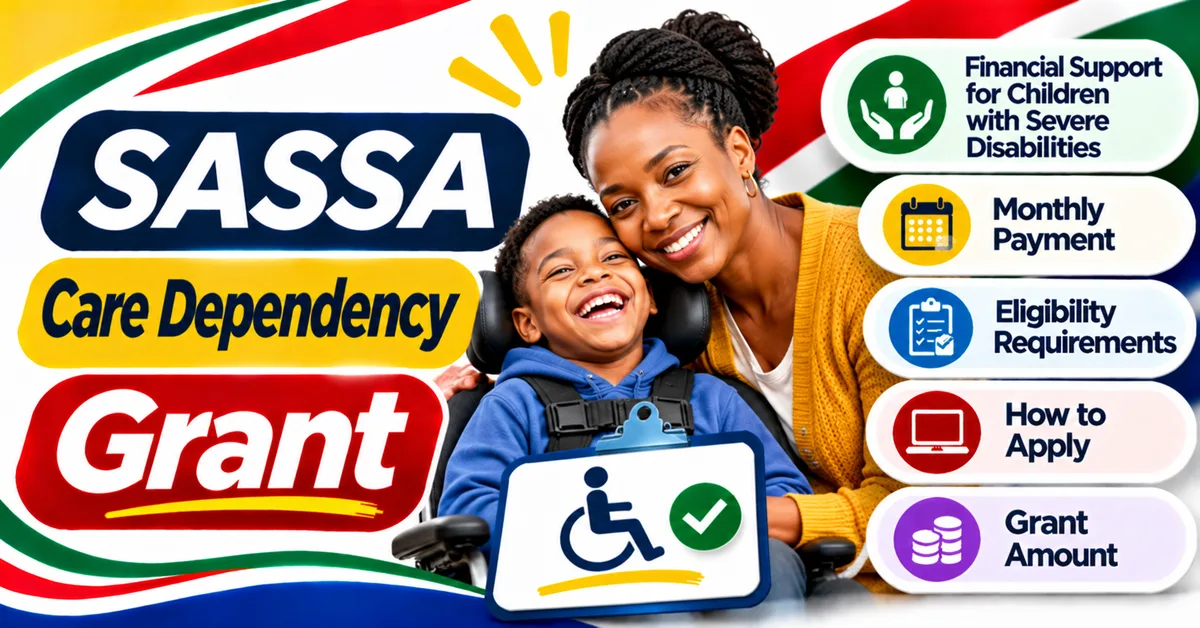
The SASSA Care Dependency Grant pays R2,400 per month, from 1 April 2026, to a parent, primary caregiver or court-appointed foster parent caring for a child under 18 with a severe disability who needs full-time, special care at home. A state medical officer must assess the child before approval, and a means test applies — except for foster parents.
What Is the SASSA Care Dependency Grant?
SASSA Grant Eligibility Checker
Check who qualifies for each SASSA grant and what it pays.
The Care Dependency Grant is a monthly payment from the South African Social Security Agency (SASSA) for someone caring for a child with a severe physical or mental disability who needs full-time, special care at home — care that goes well beyond what a child without a disability needs.
The grant covers children from birth until they turn 18. It is paid to the person caring for the child, not to the child directly, and it is meant to help with the extra costs of that care: transport to medical appointments, special food or equipment, and the time spent on full-time care.
How Much Is the Care Dependency Grant?
The Care Dependency Grant pays R2,400 per month, from 1 April 2026.
| Grant | Amount per month (from 1 April 2026) |
|---|---|
| Care Dependency Grant | R2,400 |
The grant is paid per child. If you care for more than one child who qualifies, each qualifying child can attract a grant. The amount is the same as the adult SASSA Disability Grant, but the two grants are for different people and have different rules, so do not confuse them.
Who Qualifies for the Care Dependency Grant?
You qualify if all of the following are true:
- You are the child's parent, primary caregiver, or a foster parent appointed by the court. Court-appointed foster parents are exempt from the means test — see below.
- You are a South African citizen, permanent resident or refugee, living in South Africa.
- The child is under 18 years old and lives in South Africa with you.
- The child has a severe disability and needs full-time and special care at home. The disability must be permanent and severe — a short-term illness or injury does not qualify.
- The child is not permanently cared for in a state institution. A child who lives permanently in a state institution does not qualify, because the state is already providing the care.
- You pass the means test, unless you are a foster parent (see below).
- A state medical officer assesses the child and confirms the disability before the grant is approved.
The medical assessment is not a formality. SASSA will refer the child to a state medical officer before approval, and you will need a medical or assessment report confirming permanent, severe disability. A private doctor's report alone is not enough — follow SASSA's referral process.
The Means Test — and the Foster Parent Exemption
Most applicants must pass a means test. That means your income must be below a limit set by SASSA. The means test looks at the income of you and your spouse, if you have one.
The income limits published on gov.za are:
| Applicant | Income limit per year |
|---|---|
| Single | R223,200 |
| Married (combined income) | R446,400 |
[VERIFY] Important — conflicting figures. Other sources quote different income limits for 2026/27, including R288,000 single and R576,000 married, and R256,800 single / R513,600 married. This article gives the gov.za figure above, but the limits can change. If your income is near the limit, confirm the current limit with SASSA on 0800 60 10 11 before relying on any figure on this page.
Foster parents are exempt from the means test. If you are a court-appointed foster parent, your income is not taken into account at all. You can also apply for the SASSA Foster Child Grant for the same child — SASSA's grants information states that a foster parent may receive both grants for one child.
[VERIFY] No asset limit for the Care Dependency Grant is stated in this article. No asset limit was confirmed against an official source during this draft, and different unofficial guides give different figures or none at all. Confirm with SASSA whether an asset test applies to your application.
Documents You Need to Apply
Take the following to your nearest SASSA office:
- Your 13-digit bar-coded identity document or smart ID card — for yourself and your spouse, if you have one.
- The child's birth certificate. If the child does not have one, ask SASSA which alternative identification it will accept.
- A medical or assessment report confirming the child's permanent, severe disability. Bring any medical records, clinic cards and referral letters you already have.
- The child's Road to Health clinic card, if available.
- Proof of your income — for example, payslips or a bank statement — unless you are a foster parent, who is exempt from the means test.
- Your court order, if you are a foster parent appointed by the court.
- Proof of your marital status, if applicable — for example, a marriage certificate or divorce decree, if SASSA asks for it.
Make copies of everything before you go, and keep the originals safe. A missing medical report will delay the application because the assessment cannot start without it.
How to Apply for the Care Dependency Grant
- Go to your nearest SASSA office with all the documents listed above. If you are not sure which office serves your area, phone 0800 60 10 11 first.
- Complete the application form at the office, in the presence of a SASSA official, who will help you fill it in and check your documents.
- SASSA will refer the child for a state medical officer's assessment, which happens before approval. Attend the appointment with the child's medical records and clinic card.
- Take the receipt as proof that you applied. Keep it — it has a reference you will need to follow up.
- Wait for the outcome. The application may take up to three months to process, according to gov.za.
- If approved, payment will be made into your bank account or through another SASSA payment method. For bank payment, SASSA will ask you to complete a consent form.
- If refused, ask for the reason in writing. You can ask SASSA to reconsider, and appeal if you believe the decision was wrong. Ask at the office, or phone 0800 60 10 11, for the steps and time limits.
Do not pay anyone to apply for you. The application is free. If someone offers to "speed up" your application for a fee, do not pay them — report it to SASSA.
How the Grant Is Paid
The grant is paid monthly, into a bank account or through another SASSA payment method. Make sure the account details you give are correct and in your name, and tell SASSA at once if they change.
What Happens When the Child Turns 18
The Care Dependency Grant covers children up to 18. When the child turns 18, this grant ends, and the young person must apply for the adult Disability Grant instead if their disability still prevents them from supporting themselves.
[VERIFY] The exact transition process — when to apply, whether to apply before the 18th birthday, and what medical evidence is needed again — was not confirmed against an official source during this draft. Contact SASSA at least three months before the child turns 18 and ask what to do, so there is no gap in support.
Government guidance also notes that a child receiving the grant should be tested at six to see whether special schooling is needed, and that the caregiver must make sure the child receives appropriate education and the necessary medical and dental care.
Care Dependency Grant vs Disability Grant vs Child Support Grant
The table below shows the key differences.
| Care Dependency Grant | Disability Grant | Child Support Grant | |
|---|---|---|---|
| Who it is for | Carer of a child under 18 with a severe disability | Adult aged 18–59 with a disability | Primary caregiver of a child under 18 |
| Amount (from 1 Apr 2026) | R2,400 per month | R2,400 per month | [VERIFY] Current amount not stated here — check the Child Support Grant article or sassa.gov.za |
| Means test? | Yes, except foster parents are exempt | Yes | Yes |
| Medical assessment? | Yes — state medical officer must assess the child | Yes | No |
| Child's age | Under 18 | Not applicable (adult grant) | Under 18 |
If the child you care for does not have a severe disability, the Care Dependency Grant is not the right grant. You may qualify for the SASSA Child Support Grant instead, if you meet its means test and other requirements. If you are a foster parent, check the Foster Child Grant as well — it has no means test and is based on the court order.
Common Problems and What to Do
- Application refused on medical grounds. Ask for the reason in writing and ask what further medical evidence would help. A referral form from the treating facility may be needed if a previous application was rejected on medical grounds. You can ask for reconsideration or appeal.
- Assessment appointment missed. Contact the SASSA office immediately to rebook. The application cannot be approved without the state medical officer's assessment.
- Income near the means test limit. Sources disagree on the current limit, so confirm the figure with SASSA on 0800 60 10 11 before you apply, and take proof of income with you.
- Application taking longer than three months. Take your receipt to the SASSA office or phone 0800 60 10 11 with your reference number and ask for an update. Do not submit a second application while the first is still being processed unless SASSA tells you to.
- Grant stopped. Visit your nearest SASSA office with your ID and your receipt or grant details, and ask for the reason. It may be linked to a review, a change in care arrangements, or the child turning 18.