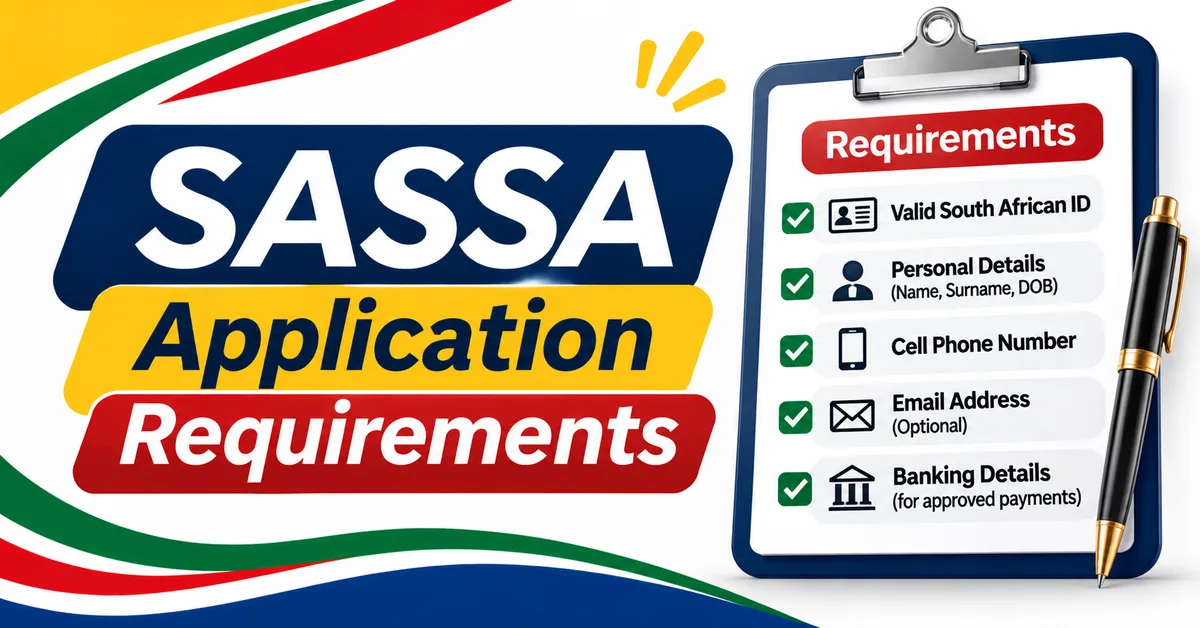
SASSA Application Requirements and Documents
There is no single SASSA document list that fits every grant. What you need depends on the grant, but most applications need your South African ID, proof of income and bank details, proof of residence, and, where relevant, documents for a spouse, child, or medical condition. The SRD grant is different: you apply online and do not upload documents.
Why There Is No Single Document List
SASSA Documents Checklist Tool
See the documents you need for each SASSA grant.
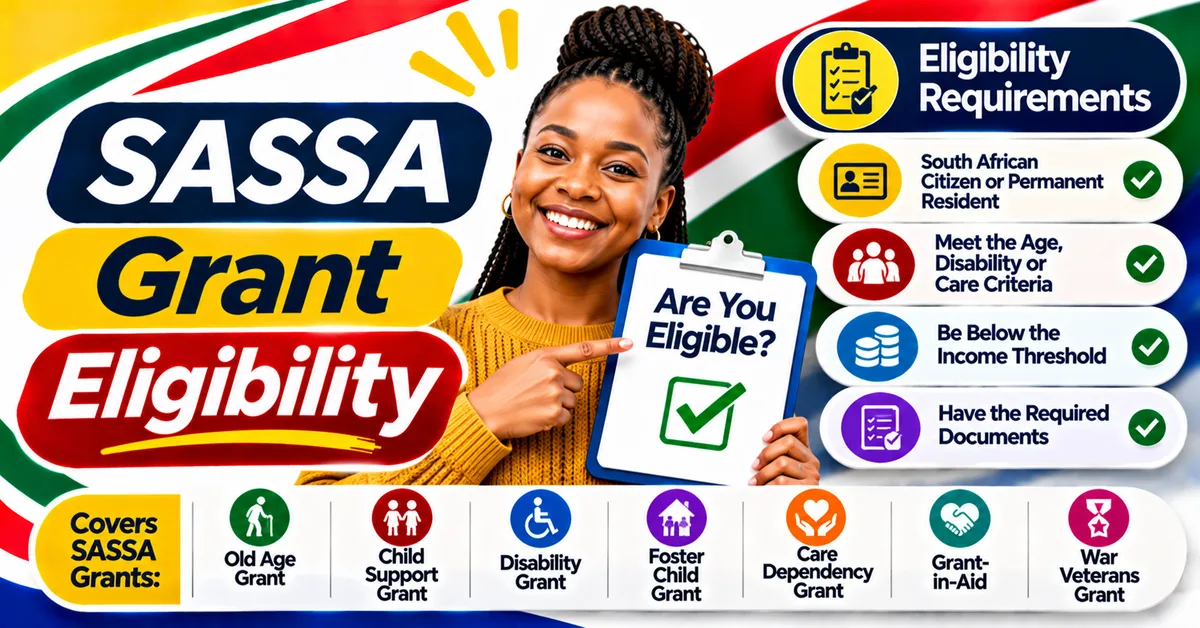
SASSA pays several different social grants, and each one has its own qualifying rules. An Older Persons Grant application is mainly about your age, identity, income and residence. A Child Support Grant application is mainly about the child in your care and your income. A Disability Grant application needs medical evidence as well. A Foster Child Grant needs a court order.
That is why a list copied from another SASSA SRD grant, or from a social media post, can mislead you. Use the checklist below, then read the grant-specific notes for your grant. If SASSA asks for a document not on this page, follow what SASSA asks for.
Master Document Checklist
Use this table as a starting point. "Where applicable" means you only need that document if it applies to your situation — for example, only if you are married, or only if you are applying for a child.
| Document or information | Who needs it | Notes |
|---|---|---|
| South African ID document or card (13-digit ID number) | Every applicant | Take the original with you to an office. |
| Proof of residence | Most permanent-grant applicants | For example, a utility bill or a letter confirming your address. |
| Proof of income | Most permanent-grant applicants | Payslips, a pension slip, or other proof of earnings, where applicable. |
| Bank statements or bank details | Most permanent-grant applicants | Where applicable, so SASSA can check your income. [VERIFY: the exact number of months of bank statements SASSA currently asks for — confirm with SASSA before applying.] |
| Marriage certificate, divorce order, or spouse's death certificate | Married, divorced, or widowed applicants | Only where applicable — SASSA may also check your spouse's income. |
| Spouse's ID and income details | Married applicants | Only where applicable. |
| Child's birth certificate and ID number | Child Support, Foster Child, and Care Dependency applicants | Proves the child's identity and your relationship to the child. |
| Proof that the child lives with you | Child Support and Care Dependency applicants | For example, a school letter or clinic card. |
| Medical report or assessment | Disability Grant and Care Dependency applicants | From a doctor or a SASSA medical assessment, as SASSA directs. |
| Court order | Foster Child Grant applicants | A court order placing the child in your foster care. |
| Proof of war service | War Veterans Grant applicants | Service records or other proof, as SASSA directs. |
| Cellphone number | Every applicant, including SRD | SASSA uses it to contact you and, for SRD, to check your status. |
Do not submit a document for a grant that does not need it. Extra documents do not improve your chances, and they can slow down an application if they create confusion about which grant you are applying for.
Identity Documents: What Counts
Your South African ID document or smart ID card is the most important document in any SASSA application. SASSA uses your 13-digit ID number to check your identity against government records, to check whether you already receive a grant, and to link your application to your payments.
If you apply in person, take your original ID. A copy on its own is usually not enough at an office, because the official needs to see the original. If you apply online through the Services Portal at services.sassa.gov.za, you will need your ID number to register and to complete the application.
What to do if you do not have an ID
If you do not have an ID document, still ask SASSA for help — but do not expect a grant to be approved without proof of who you are. Go to a SASSA office with whatever identity documents you have and explain your situation. SASSA can tell you what it will accept and whether you need to apply for an ID at Home Affairs first.
If your ID has been lost or stolen, report it and apply for a replacement at Home Affairs, and keep proof that you have applied. A grant cannot be paid without a verified identity.
Certified Copies and Uploading Documents Online
For permanent grants applied for through the Services Portal at services.sassa.gov.za, SASSA asks you to upload documents as part of the online application. The portal generally accepts PDF documents, so scan or photograph your documents clearly before you start. Make sure every page is readable and fully visible — a cut-off or blurred page may delay your application.
SASSA may ask for certified copies of some documents. A certified copy is a copy that has been stamped and signed by an authorised person, such as a commissioner of oaths at a police station, to confirm it is a true copy of the original. Take the original document with you when you get a copy certified, because the person certifying it needs to compare the two.
[VERIFY: any claim that certified copies must be less than three months old — this is widely repeated online but was not confirmed from an official SASSA source for this article, so do not rely on a three-month rule. Ask SASSA or the office handling your application how recent a certified copy must be.]
Keep your originals safe. Do not leave original documents with anyone who offers to apply on your behalf for a fee. Applying for a SASSA grant is free, and no one needs to keep your original ID or bank card to help you.
Income, Bank Details and Means Testing
Most permanent grants have a means test. That means SASSA checks your income — and, if you are married, your spouse's income — to decide whether you qualify. The exact income limit depends on the grant and on whether you are single or married.
This article does not give rand thresholds for the permanent grants, because the 2026 SASSA booklet does not publish all of them in one place in a way that could be verified for this article. [VERIFY: the specific means-test rand thresholds for each non-SRD grant — confirm the current figure for your grant with SASSA before you apply or rely on a number you saw online.] Do not use a threshold from an old article or a social media post to decide whether you qualify. Ask SASSA, or check the current information on sassa.gov.za.
The one means test that is confirmed for this article is for the SRD grant: R624 per month in bank inflows. If more than R624 comes into your bank account in a month, you may not qualify for the SRD grant for that month. The SRD grant is assessed month by month, so a change in your bank inflows can change the outcome for a later month.
For permanent grants, SASSA may ask for your bank statements and account details so it can check your income and, if approved, pay the grant into your account. Give the details of an account in your own name, and never share your PIN or banking password with anyone.
Grant-Specific Document Notes
Older Persons Grant
You need your ID to prove your age and identity, proof of residence, and proof of your income and bank details. If you are married, SASSA may also need your spouse's ID and income details. There is no separate medical document for this grant, unless SASSA asks for something specific in your case.
Disability Grant
In addition to your ID, proof of residence, income and bank details, you need medical evidence of your disability. SASSA will direct you on whether to bring a medical report from your doctor or to attend a medical assessment arranged through SASSA. Do not invent or buy a medical report.
[VERIFY: any exact age limit for a disability assessment — no specific age limit is stated as confirmed in this article. Confirm with SASSA if an age rule is mentioned in your case.]
Child Support Grant
You need your ID, proof of residence, income and bank details, and the child's birth certificate. SASSA may also ask for proof that the child lives with you, such as a school letter or clinic card. You do not need a court order for a Child Support Grant — that is a requirement for the Foster Child Grant, not this one.
Foster Child Grant
You need your ID, proof of residence, income and bank details, the child's birth certificate, and the court order that placed the child in your foster care. The court order is the key document for this grant. Without it, SASSA cannot treat the application as a Foster Child Grant application.
Care Dependency Grant
You need your ID, proof of residence, income and bank details, the child's birth certificate, and medical evidence that the child needs full-time care because of a severe disability, as SASSA directs.
Grant-in-Aid
Grant-in-Aid is an additional grant for a person who already receives an Older Persons, Disability or War Veterans Grant and needs full-time care from another person. You need your ID and the medical evidence SASSA asks for. Do not apply for it on its own as a standalone grant — it is linked to the main grant you already receive.
War Veterans Grant
You need your ID, proof of residence, income and bank details, and proof of your war service, as SASSA directs. This grant is for a small group of people who served in the Second World War or the Korean War.
SRD Grant (R370)
The SRD grant is different from all the grants above. You apply online at srd.sassa.gov.za, and you do not upload documents in the SRD form. Instead, SASSA checks your identity and your finances against government and bank databases. You need your 13-digit South African ID number and the cellphone number you used when you applied. You must be between 18 and 59 years old, and your bank inflows must not be more than R624 per month. The SRD grant is R370 per month and has been extended to 31 March 2027.
Do not pay anyone to upload documents for an SRD application. There is no document upload step, and anyone charging a fee for it is not acting for SASSA.
What to Do If You Do Not Have a Document
If a document is missing, work through these steps in order:
- Check whether the document is actually needed for your grant — do not chase a document another grant needs.
- Ask SASSA what it will accept instead. If you do not have a utility bill in your name, ask whether a letter confirming your address will do.
- Go to the office that issues the document: Home Affairs for a birth certificate, the court for a court order, your doctor or clinic for a medical report.
- Keep proof that you have applied for the missing document, such as a receipt, and take it with you when you visit SASSA.
- Do not submit a false document. It can lead to your application being declined, your grant being stopped, or a fraud investigation.
If you are not sure whether a document is needed, call SASSA on the toll-free line 0800 60 10 11 or visit your nearest SASSA office before you travel a long distance to fetch it.